The 2,000-Year-Old Analog Computer That Baffled Modern Science: Inside the Antikythera Mechanism
How a corroded bronze artifact recovered from an ancient Roman shipwreck in Greece overturned our understanding of classical engineering, mechanical computation, and astronomical history.
Quick Story Highlights & Facts
1. Quick Facts & Executive Overview
In the spring of 1900, a crew of Greek sponge divers seeking refuge from a violent Aegean storm dropped anchor off the treacherous cliffs of Antikythera, a tiny island situated between Crete and the Peloponnese. When diver Elias Stadiatis plunged forty-five meters beneath the surface, he did not find sea sponges. Instead, he surfaced in a state of sheer panic, gasping through his brass helmet about a seabed littered with “a heap of rotting corpses and horses.”
What Stadiatis had stumbled upon was the graveyard of a massive Roman cargo vessel that foundered around 60 BCE, laden with looted treasures, marble masterpieces, and classical bronze statues. Yet the most profound discovery of human history was not the glittering statues. It was a corroded, calcified green lump no larger than a thick encyclopedia—retrieved from the silt and designated simply as Inventory Item 15087 at the National Archaeological Museum in Athens.
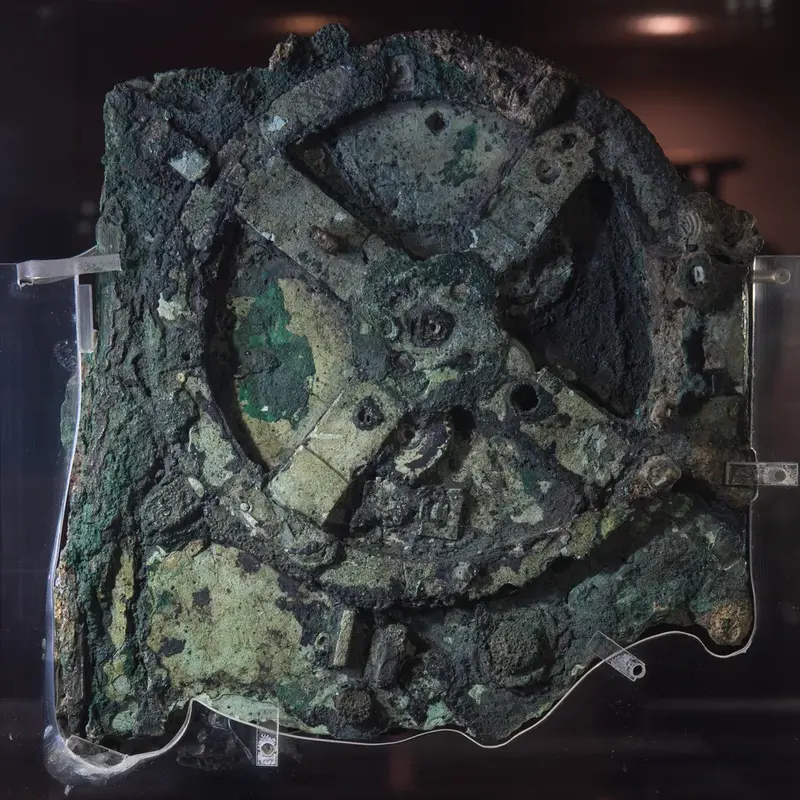
For months, conservators disregarded the lump as ballast stone debris. Then, as the ancient wood dried and cracked open in 1902, archaeologist Valerios Stais caught a glimpse of something impossible: polished gear teeth measuring less than two millimeters across, triangular cogs, and microscopic Greek epigraphy embedded inside solid bronze sheets.
Before this fateful morning, modern historians universally agreed that complex mechanical clockwork had first been engineered in fourteenth-century Western Europe. The Antikythera Mechanism obliterated that consensus, proving that ancient Hellenistic astronomers possessed mechanical computing technology more than a thousand years ahead of its recognized historical timeline.
2. The Anatomy of an Ancient Masterpiece
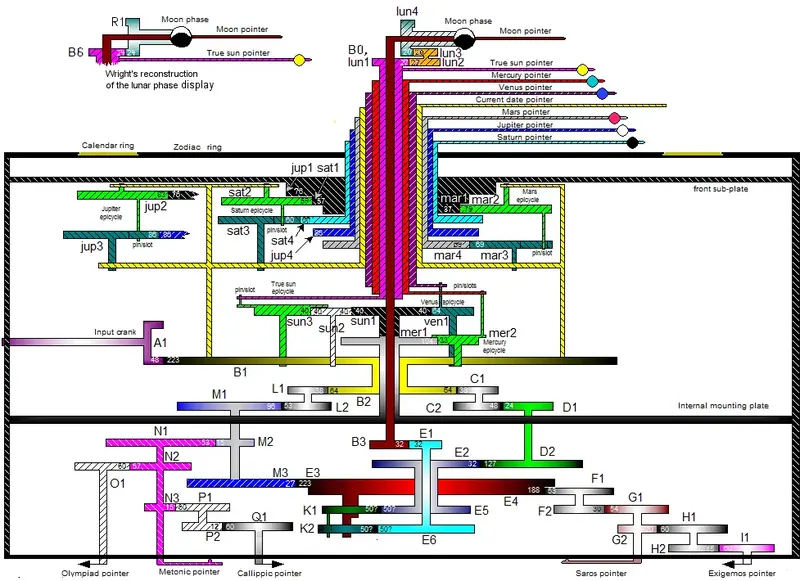
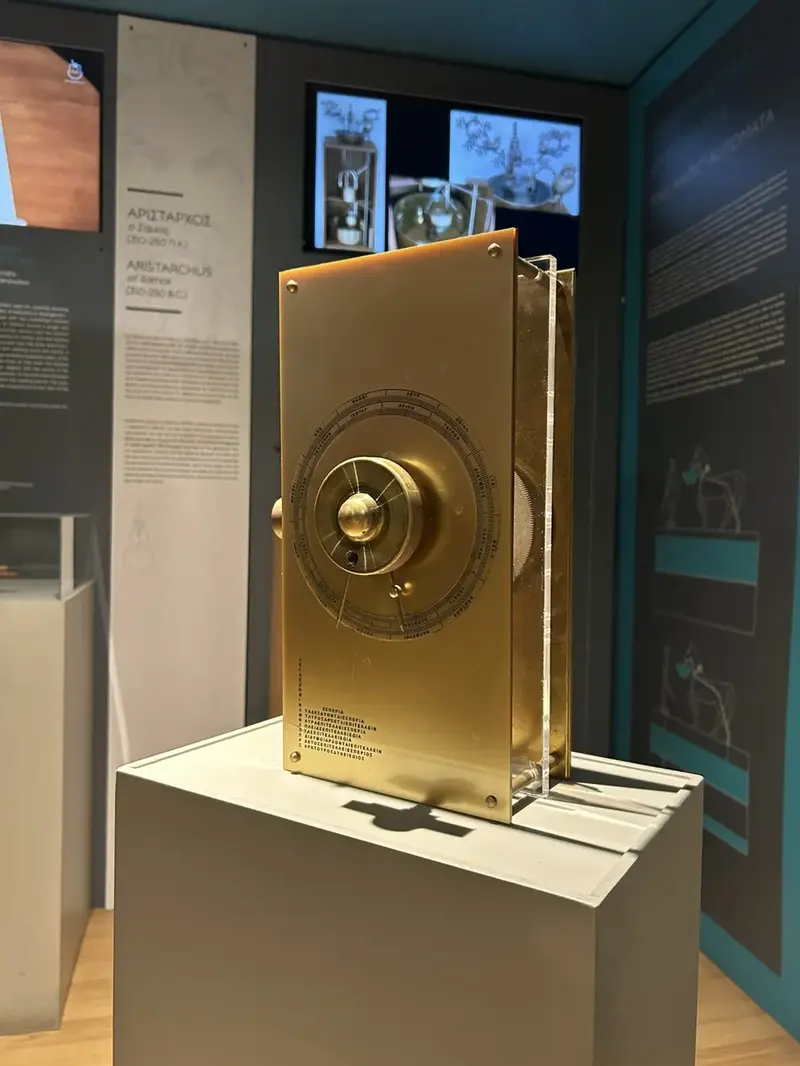
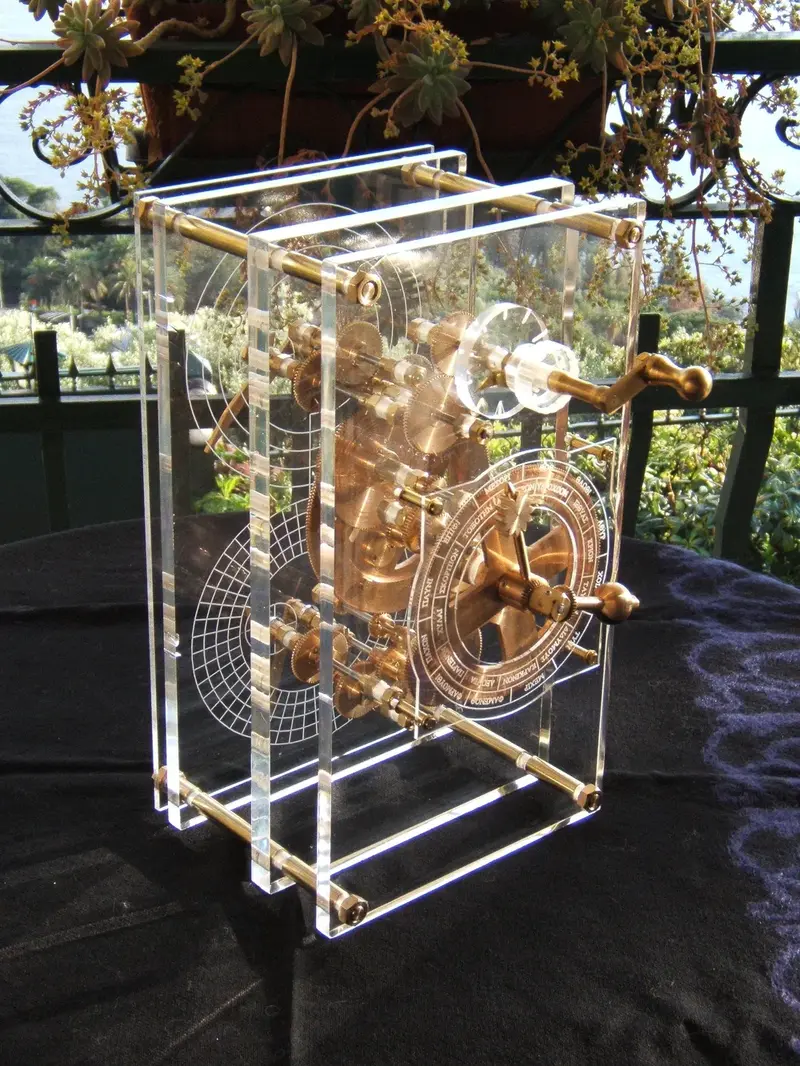
When complete, the Antikythera Mechanism was an intricate, hand-cranked orrery enclosed within a bronze-plated wooden case roughly 340 mm tall, 180 mm wide, and 90 mm deep. It functioned as an analog calculating machine capable of tracking celestial cycles with mathematical precision.
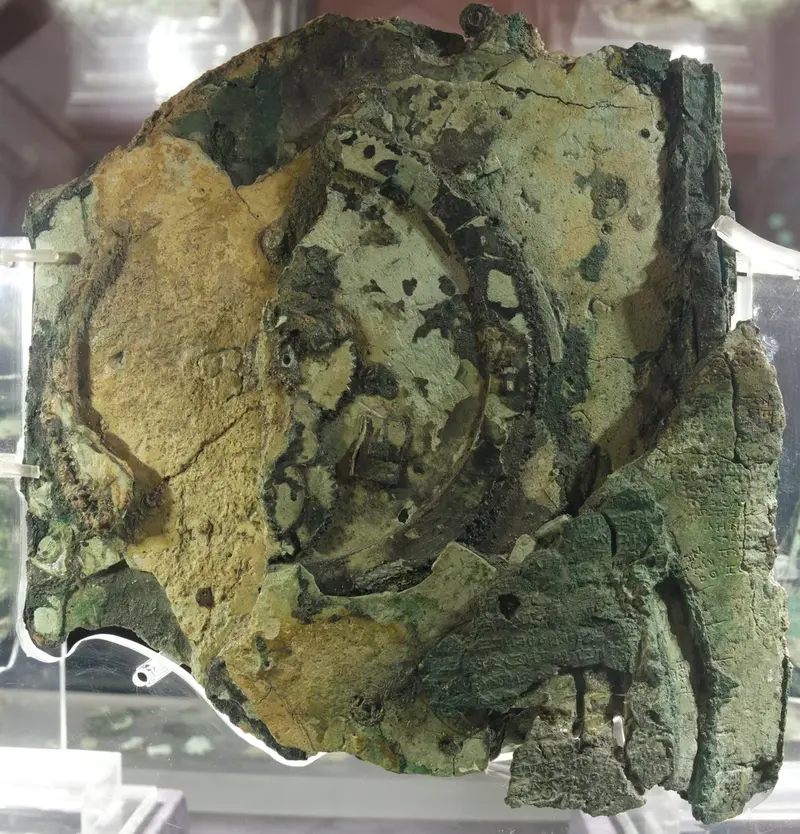
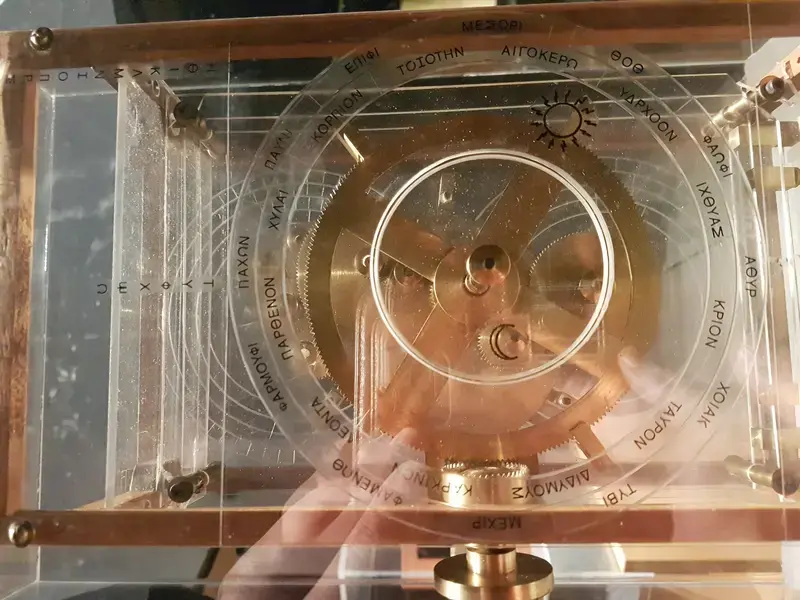
By turning a small side handle, the operator drove a central solar crown wheel that engaged over thirty hand-crafted bronze gears. On the front dial, bronze pointers with miniature spheres of colored glass and gold simulated the dance of the cosmos:
- The Sun Pointer: Indicating the exact date on a 365-day Egyptian solar calendar ring, adjustable for leap years.
- The Moon Pointer: Rotating around a 360-degree Greek Zodiac ring divided into twelve signs.
- The Phases of the Moon: Driven by a miniature mechanical differential gear that spun a two-tone black and silver sphere inside a tiny porthole to reveal real-time lunar phases.
- The Five Classical Planets: Sophisticated epicyclic (gear-on-gear) pinions that reproduced the retrograde wanderings of Mercury, Venus, Mars, Jupiter, and Saturn.
3. High-Tech Archaeology: Peering Inside Solid Bronze
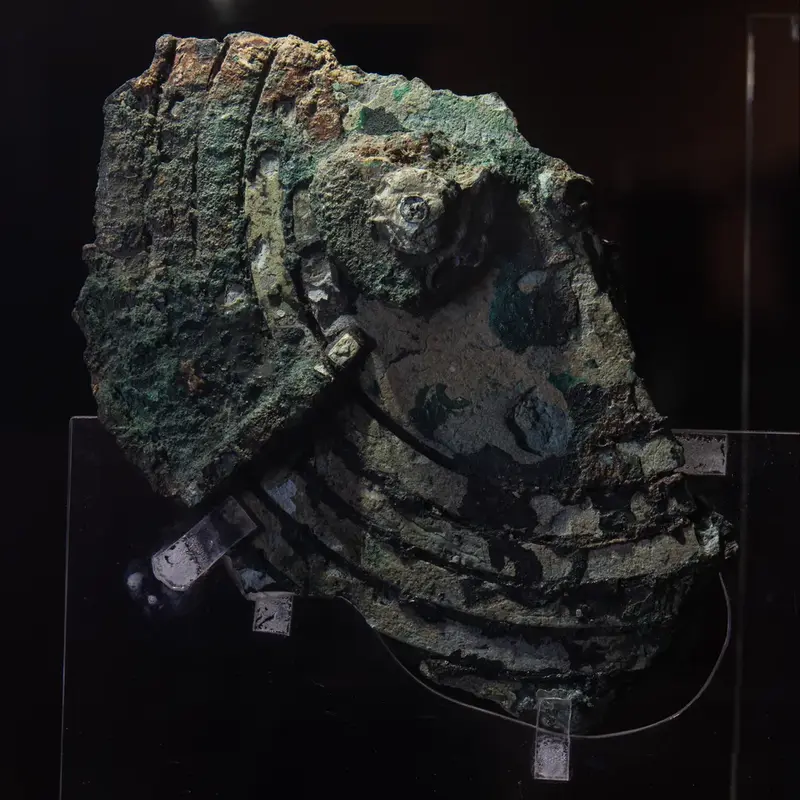
For more than half a century after its discovery, skepticism remained widespread. Critics claimed the mechanism must have been dropped onto the shipwreck by an eighteenth-century vessel. That skepticism collapsed in the 1970s when English physicist Derek de Solla Price collaborated with Greek radiographer Charalampos Karakalos to produce the first gamma-ray and X-ray radiographs of the fragments.
In 2005, an international consortium known as the Antikythera Mechanism Research Project (AMRP)—bringing together teams from Cardiff University, the University of Athens, Hewlett-Packard, and X-Tek Systems—transported a custom eight-tonne micro-focus CT scanner (the BladeRunner) directly to the museum in Athens.
The resulting three-dimensional X-ray computed tomography sliced through the heavily oxidized bronze with sub-millimeter clarity, revealing:
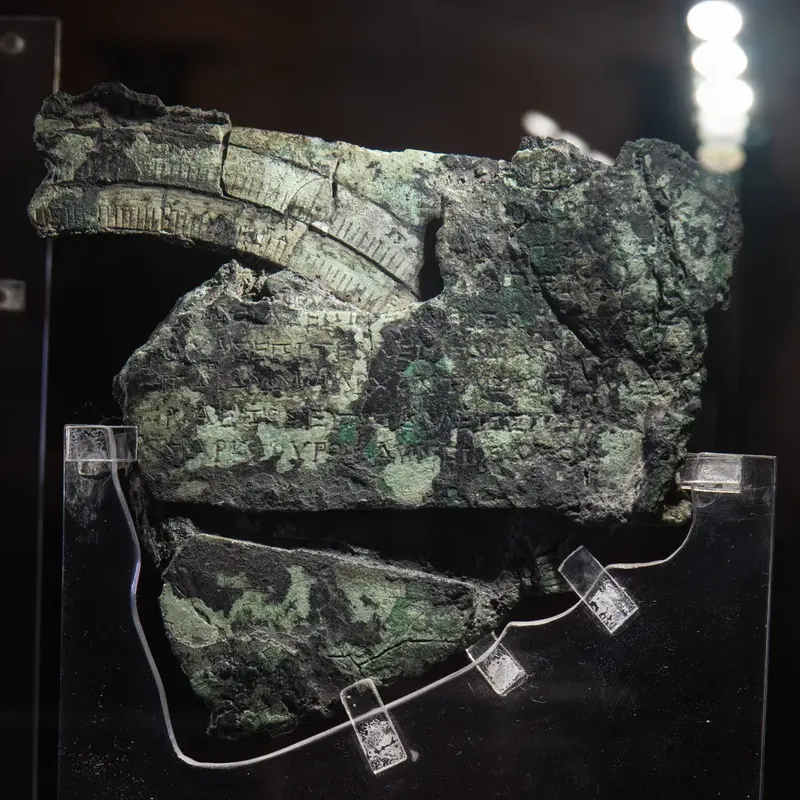
- Over 3,400 hidden Greek characters inscribed on internal door plates, functioning as a comprehensive user operating manual.
- The exact tooth counts for twenty-seven surviving bronze gears, along with clear radiographic evidence for at least ten additional missing pinions.
- A completely unrecorded epicyclic differential gear arrangement that anticipated mechanical clocks by 1,400 years.
4. Modeling the Lunar Anomaly: The Pin-and-Slot Masterstroke
The most mathematically breathtaking component of the Antikythera Mechanism is located behind the main drive wheel: the Lunar Epicyclic Gear Pair (Gears k1 and k2).
Ancient astronomers understood that the Moon does not orbit the Earth at a constant speed; it accelerates as it reaches perigee (closest approach) and decelerates toward apogee (farthest distance). Modern physics explains this through Kepler’s second law of planetary motion across an elliptical orbit. But ancient Greeks worked strictly within a geocentric framework.
To reproduce this variable velocity mechanically, the Greek engineer designed two identical 53-tooth bronze gears mounted slightly off-center (eccentric) from each other by barely 1.1 millimeters. A tiny bronze pin on the driving gear slid within a narrow radial slot cut into the driven gear.
As the driving gear rotated at a uniform speed, the distance between the pin and the driven axle continually expanded and contracted. This caused the driven gear—and consequently the Moon pointer on the front dial—to speed up and slow down in exact alignment with the Moon’s real-world anomalous motion.
5. The Rear Dials: Predicting Eclipses and the Olympic Games
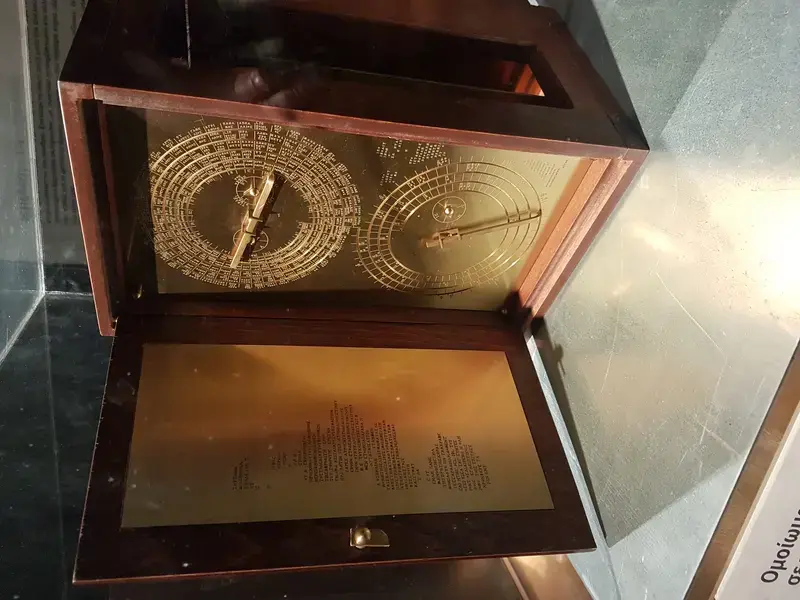
The back panel of the mechanism was dominated by two expansive spiral dials, each read using a sliding bronze pin that followed a spiral groove cut into the bronze casing:
The Upper Spiral: The 19-Year Metonic Calendar
Spanning five concentric turns, this dial contained 235 lunar months—the precise duration after which the solar and lunar cycles re-synchronize (19 solar years). Subordinate auxiliary dials tracked the 76-year Callippic cycle and the prestigious Panhellenic Games.
Remarkably, the Olympiad dial tracked the sacred four-year athletic competitions of antiquity, explicitly engraving the host cities: Olympia, Delphi (Pythian Games), Isthmia, and Nemea.
The Lower Spiral: The 223-Month Saros Eclipse Predictor
Spanning four concentric turns with 223 lunar months, this dial forecasted both solar and lunar eclipses. Glyphs etched into specific month cells predicted:
- The exact hour of the eclipse.
- Whether the eclipse would be solar ($\Sigma$ for Selene / Moon) or lunar ($H$ for Helios / Sun).
- The direction of shadow entry and obscuration color.
- An auxiliary triple dial (Exeligmos) adjusted the hour calculation across a full 54-year cycle.
6. Who Built the Antikythera Mechanism?
The identity of the genius behind the mechanism remains one of archaeology’s greatest detective stories. Several prominent classical figures stand as prime candidates:
- Archimedes of Syracuse (c. 287 – 212 BCE): Roman statesman Cicero recorded in De Re Publica that Roman general Marcellus seized a brass sphere crafted by Archimedes following the sack of Syracuse in 212 BCE. Cicero described a machine that simulated the motions of the Sun, Moon, and five planets, matching the Antikythera Mechanism’s core architecture.
- Hipparchus of Nicaea (c. 190 – 120 BCE): The greatest observational astronomer of the ancient world worked on the island of Rhodes—a port directly along the sailing route of the ill-fated Roman cargo vessel. Hipparchus was the mathematical pioneer who calculated the Moon’s variable speed, the exact theory physically encoded within the pin-and-slot gear train.
- Posidonius of Rhodes (c. 135 – 51 BCE): Cicero explicitly noted that he visited Posidonius in Rhodes and observed a device that “at each revolution reproduces the same movements of the sun, the moon and the five wandering stars.”

7. The Lost Technological Renaissance
The Antikythera Mechanism stands as a haunting monument to lost knowledge. Its sheer mechanical sophistication demonstrates that the gap between classical Greek mathematics and physical engineering was far narrower than modern historians once presumed.
Had the mechanical traditions embodied by this thirty-gear computer survived the collapse of the Western Roman Empire rather than resting entombed under forty-five meters of Mediterranean silt, humanity’s scientific renaissance might have begun a millennium earlier.
Frequently Asked Questions (FAQ)
What was the Antikythera Mechanism used for?
The Antikythera Mechanism was an ancient Greek analog calculating computer designed to compute and display astronomical phenomena. It tracked the positions of the Sun, Moon, and the five known planets, simulated the phases of the Moon, predicted solar and lunar eclipses decades in advance, and tracked the four-year calendar of the ancient Olympic Games.
How old is the Antikythera Mechanism?
Radiocarbon dating of organic wooden fragments combined with astronomical inscription analysis dates the mechanism between 205 BCE and 87 BCE, making it well over 2,000 years old.
Why is the Antikythera Mechanism so significant?
Before its discovery, modern historians believed that complex mechanical gearing and differential gear trains only emerged in fourteenth-century Europe with the advent of mechanical cathedral clocks. The mechanism proved that classical Hellenistic civilization possessed mechanical engineering capabilities over 1,400 years ahead of previously established timelines.
Where can you see the original Antikythera Mechanism today?
All eighty-two recovered fragments of the original mechanism are permanently preserved and exhibited in the dedicated Bronze Collection of the National Archaeological Museum in Athens, Greece.
CurioVault Editorial Desk
Curating extraordinary stories, historical mysteries, and cultural wonders from around the world. All companion videos are embedded directly from official creators and open channels for educational review.
More Fascinating Stories
Browse All → 14:20 Video
The Sailing Stones of Death Valley: How Massive Boulders Move on Their Own
 16:15 Video
The Lost Amber Room: How the Eighth Wonder of the World Vanished Without a Trace
 21:10 Video